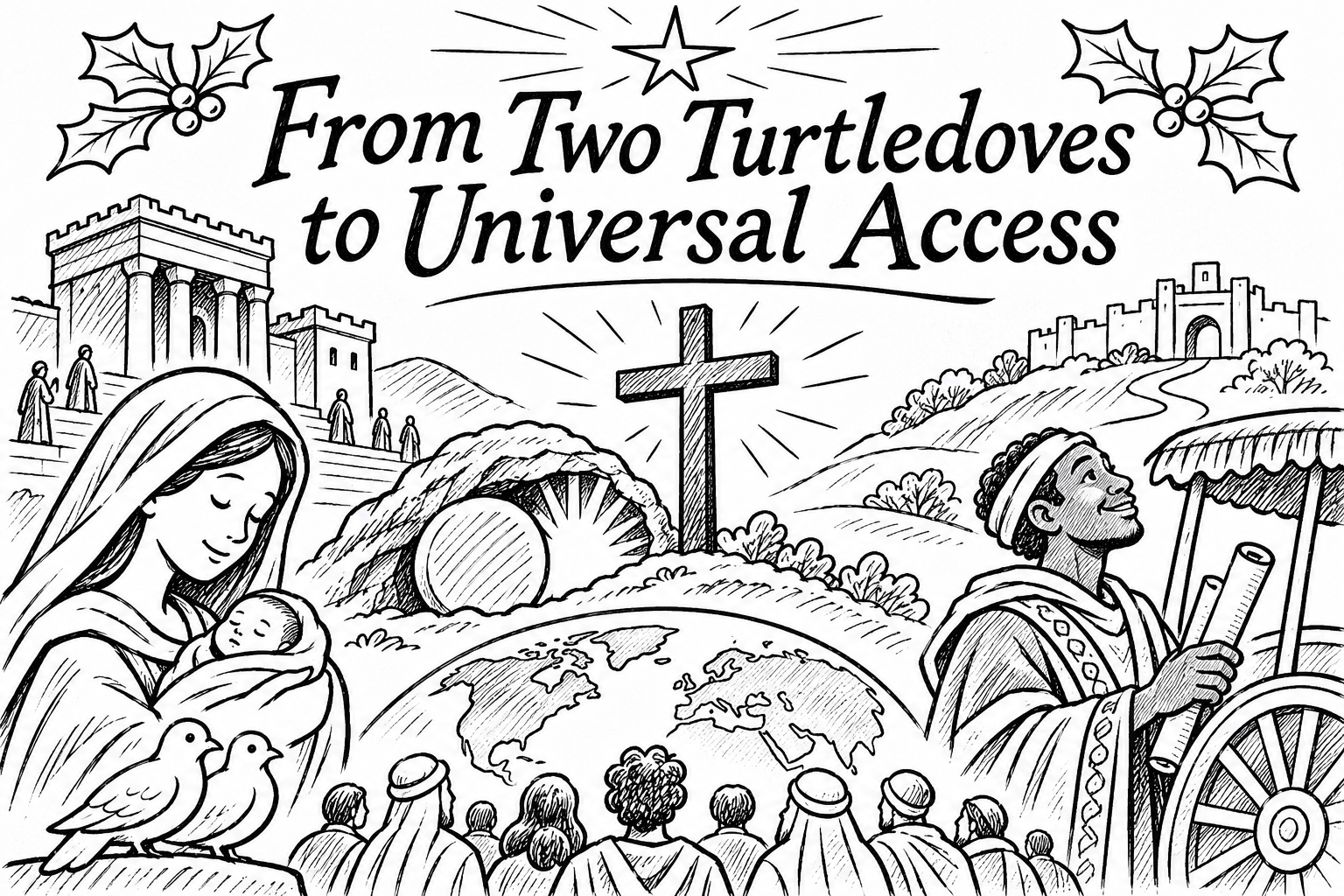
Mary and the two turtledoves
Every Christmas, people sing about two turtledoves in “The Twelve Days of Christmas.” Whether intentional or not, this provides a wonderful connection to the biblical account of Mary’s purification following the birth of Jesus.
According to Leviticus 12:6–8, a woman who had given birth was required to bring an offering for her purification. If she could not afford a lamb, she could bring two turtledoves or two young pigeons.
Mary fulfilled this requirement in Luke 2:22–24.
Mary had not committed a moral transgression by giving birth. Rather, her ritual condition needed to be addressed under the Levitical system in order for her to approach Yahweh at His geographically located sanctuary (Leviticus 12:4; 15:31).
The remarkable irony is that Mary participated in a sacrificial system that her own son would eventually render unnecessary (Hebrews 10:9–14).
The purpose and limitations of the Levitical system
The Levitical system was a temporary, covenant-specific arrangement through which Israel could approach the geographically located, publicly manifested presence of Yahweh (Exodus 25:8; 29:42–46; Hebrews 9:8–10).
The system involved:
A geographically established sanctuary (Exodus 25:8).
A designated priesthood through Aaron (Exodus 28:1).
Sacrificial and ritual purification requirements (Leviticus 12:1–8; 16:15–19).
Restrictions based upon ritual and physical conditions (Leviticus 15:31; Deuteronomy 23:1).
Regulations governing covenant participation (Exodus 12:43–49).
This does not mean that people outside Israel were incapable of seeking Yahweh or having a relationship with Him (2 Kings 5:15–19; Acts 17:26–27). Rather, approaching His geographically established sanctuary was governed by the particular requirements of the Mosaic covenant (Leviticus 16:2; Numbers 18:1–7).
Two different priesthoods
Jesus did not come to perpetuate the Aaronic priesthood. He belongs to an entirely different priesthood—the order of Melchizedek (Psalm 110:4; Hebrews 7:11–17).
Melchizedek was a priest of God Most High before Israel existed, before circumcision was instituted as a covenant sign, and before the Mosaic covenant was established (Genesis 14:18–20; 17:9–14; Exodus 19:3–6).
His priesthood was not dependent upon Israel’s national identity.
Aaronic priesthood – Priesthood of Jesus
Established under Moses (Exodus 28:1) – According to the order of Melchizedek (Hebrews 5:5–6)
Mosaic covenant (Hebrews 7:11) – New covenant (Hebrews 8:6–13)
Israel-centered (Exodus 28:9–12) – All humanity in view (1 Timothy 2:5–6)
Genealogical qualification (Exodus 28:1) – Power of an indestructible life (Hebrews 7:16)
Geographically located sanctuary (Exodus 25:8–9) – Heavenly sanctuary (Hebrews 9:24)
Repeated sacrifices (Hebrews 10:11) – Once-for-all sacrifice (Hebrews 10:12–14)
Mortal priests (Hebrews 7:23) – Permanent priesthood (Hebrews 7:24–25)
The Aaronic priesthood facilitated approach to Yahweh within the Mosaic covenant, including provisions for foreigners (Numbers 15:14–16). The priesthood of Jesus makes new covenant participation available to all humanity (1 Timothy 2:5–6; Hebrews 7:25).
What Jesus accomplished
Through His death, Jesus addressed the problem of sin, inaugurated the new covenant, and opened the way for humanity to approach God without participating in the Levitical sacrificial system (2 Corinthians 5:19–20; Hebrews 9:11–15; 10:19–22).
In other words, no additional animal sacrifice, geographical pilgrimage, or Levitical purification is necessary (Hebrews 10:18–22; John 4:21–24).
Jesus anticipated this historical transition in His conversation with the Samaritan woman:
John 4:21 (NRSV) – Jesus said to her, “Woman, believe me, the hour is coming when you will worship the Father neither on this mountain nor in Jerusalem.”
Paul also describes the universal scope of this access:
Ephesians 2:18 (NRSV) – for through him both of us have access in one Spirit to the Father.
God’s initiative is universal in scope, while participation in the new covenant is received through faith and allegiance to Jesus (2 Corinthians 5:19–20; Romans 5:1–2; Ephesians 3:12).
The Ethiopian eunuch
The account of the Ethiopian eunuch in Acts 8 provides a compelling illustration of the practical significance of this covenantal transition.
According to Deuteronomy 23:1, a man with certain physical mutilations was prohibited from entering the assembly of Yahweh. Although the precise extent of this restriction is debated, the eunuch’s physical condition presented a potential barrier to full covenant participation.
Nevertheless, Isaiah anticipated a time when faithful eunuchs would be welcomed:
Isaiah 56:3-7 (NRSV) – Do not let the foreigner joined to the LORD say,
“The LORD will surely separate me from his people”;
and do not let the eunuch say,
“I am just a dry tree.”
For thus says the LORD:
To the eunuchs who keep my sabbaths,
who choose the things that please me
and hold fast my covenant,
I will give, in my house and within my walls,
a monument and a name
better than sons and daughters;
I will give them an everlasting name
that shall not be cut off.
And the foreigners who join themselves to the LORD,
to minister to him, to love the name of the LORD,
and to be his servants,
all who keep the sabbath, and do not profane it,
and hold fast my covenant—
these I will bring to my holy mountain,
and make them joyful in my house of prayer;
their burnt offerings and their sacrifices
will be accepted on my altar;
for my house shall be called a house of prayer
for all peoples.
Remarkably, the Ethiopian eunuch was reading Isaiah 53 when Philip encountered him (Acts 8:28–33).
After Philip explained the good news about Jesus, the eunuch asked:
Acts 8:36 (NRSV) – “Look, here is water! What is to prevent me from being baptized?”
The Greek word κωλύω (kōlyō) means to hinder, prevent, forbid, or restrain.
His question is particularly significant in light of his physical condition. It is reasonable to suggest that his enthusiasm for baptism may have resulted from discovering that nothing about his physical condition prevented him from participating in the new covenant, although Acts does not explicitly state his motivation (Deuteronomy 23:1; Isaiah 56:3–5; Acts 8:35–39).
The same Greek word appears in Acts 10:47 when Peter questions whether anyone can prevent the Gentiles from being baptized.
Both accounts illustrate the removal of barriers to covenant participation (Acts 8:36–39; 10:28, 44–48).
Mary, Jesus, and the Ethiopian eunuch
Together, these three individuals illustrate a major transition in biblical history.
Mary – Participates in the purification requirements of the Mosaic covenant (Luke 2:22–24).
Jesus – Inaugurates the new covenant and serves as high priest according to the order of Melchizedek (Hebrews 7:17–28; 9:15).
Ethiopian eunuch – Illustrates the accessibility of the new covenant regardless of physical condition, nationality, or geographical location (Acts 8:26–39).
Mary traveled to Jerusalem and brought two turtledoves (Luke 2:22–24). The Ethiopian eunuch was baptized along a desert road without bringing an animal sacrifice, undergoing Levitical purification, or having to return to Jerusalem (Acts 8:26, 36–39). What happened between these two events was the death, resurrection, and exaltation of Jesus Christ (Matthew 27:50–51; Acts 2:22–36; Hebrews 10:12–14).
The overarching theological significance
The transition was not from a God who was inaccessible to humanity to a God who suddenly became accessible (Genesis 14:18–20; 2 Kings 5:15–19; Acts 17:26–27).
Rather, it was a transition from a temporary, geographically centered, Israel-specific covenantal arrangement to a universally accessible new covenant administered through an eternal high priest (John 4:21–24; Hebrews 7:23–28; 9:8–15; 1 Timothy 2:5–6).
Through Jesus Christ, reconciliation, peace, and access to God’s presence have been made available to all humanity (2 Corinthians 5:19–20; Colossians 1:19–20; Ephesians 2:14–18).
Nationality, geographical location, and physical condition no longer determine eligibility for covenant participation (Acts 10:28, 34–35; John 4:21–24; Acts 8:36–39).
Anyone who responds in faithful allegiance to Jesus can become part of God’s holy people (Galatians 3:26–29; 1 Peter 2:9–10).
A concluding Christmas reflection
Every Christmas, whenever we hear about two turtledoves in the song “The Twelve Days of Christmas,” we should reflect on its biblical significance…
Following the birth of Jesus, Mary brought two turtledoves to Jerusalem to fulfill the purification requirements of the Levitical system (Leviticus 12:6–8; Luke 2:22–24). Remarkably, the very child she brought to Jerusalem would one day offer Himself, inaugurating a new covenant and bringing an end to the necessity of that sacrificial system (Hebrews 9:11–15; 10:9–18).
The significance of this transition is beautifully illustrated years later in the account of the Ethiopian eunuch. Upon hearing the good news about Jesus, he would discover that nothing about his physical condition prevented him from participating in the new covenant (Isaiah 56:3–5; Acts 8:35–39).
This illustrates an important distinction between the priesthood of Aaron and that of Jesus. Whereas Aaron’s priesthood facilitated Israel’s approach to Yahweh under the Mosaic covenant, the priesthood of Jesus opened the way for all humanity to participate in the new covenant (Exodus 28:1; Hebrews 7:11–28; 1 Timothy 2:5–6).
And so, the child whose mother brought two turtledoves to Jerusalem would ultimately make it possible for anyone, anywhere, to approach Yahweh through Him without ever having to bring a sacrifice of their own (John 4:21–24; Hebrews 10:18–22; Ephesians 2:18).
Godspeed, to the brethren!
Check out my book!


